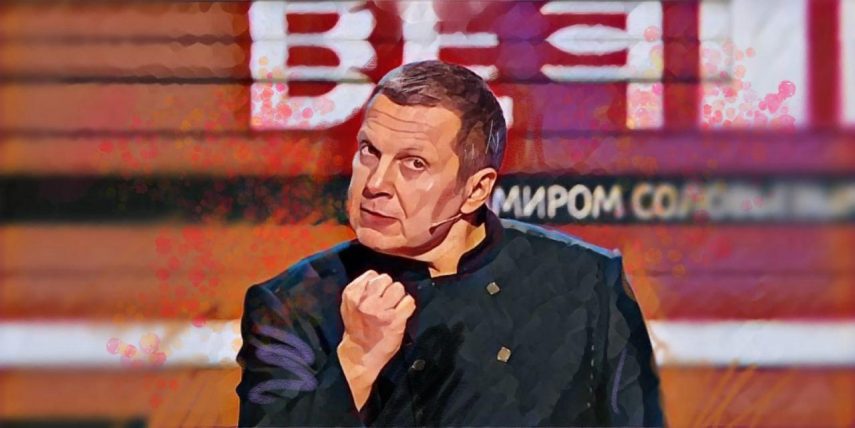
Controversial remarks by Russian television host Vladimir SOLOVYOV, suggesting that Moscow could launch “special military operations” in Central Asia and Armenia, have provoked a strong backlash in Uzbekistan, where scholars, journalists, and political analysts warn that such rhetoric reflects dangerous political tendencies.
Speaking on his Solovyov Live program, the prominent pro-Kremlin commentator claimed that regions like Armenia and Central Asia are far more critical to Russia’s national interests than distant allies such as Syria or Venezuela. He urged Russian authorities to abandon international law if it stands in the way of what he described as Russia’s national security.
Solovyov was born in Moscow in 1963 and trained in economics and philosophy; after the collapse of the Soviet Union, he spent part of the early–mid-1990s living in the United States, where he worked as a businessman involved in commercial ventures rather than journalism or politics, before returning to Russia following financial difficulties. In the late 1990s and early 2000s, he entered radio and television, initially presenting himself as a liberal, pro-market commentator, but over time evolving into one of Russia’s most prominent pro-Kremlin television hosts, known for his hardline nationalist rhetoric and for aggressively promoting state narratives on domestic and foreign policy.
“We must say openly: the games are over. International law and the international order mean nothing to us,” Solovyov declared, openly questioning why, if a so-called special military operation was justified in Ukraine, similar actions should not be carried out elsewhere within Russia’s claimed zone of influence.
Solovyov characterized Central Asia as “our Asia,” framing it as part of Russia’s rightful sphere of influence. He warned that instability in the region represents a direct threat to Russia’s security and advocated for the Kremlin to clearly define the boundaries of its “zone of influence,” regardless of international norms.
He also criticized Russia’s approach to the war in Ukraine, arguing that a lack of early harsh measures prolonged the conflict and resulted in greater losses. “We should stop casting pearls before swine and openly state that we do not care what Europe thinks,” he added.
In recent years, tensions over Russian attitudes toward Central Asia have surfaced in regional discourse. In 2024, Uzbek political figure Alisher QODIROV publicly criticized what he called rising “Russian chauvinism,” responding to televised statements by Russian nationalists such as Zakhar Prilepin advocating territorial claims on Uzbekistan and Russian commentators on state TV asserting that peoples like the Uzbeks and Kazakhs did not exist before 1917, comments that Qodirov said were enough to call for cutting Russian broadcasts into Uzbekistan. Observers have also linked broader social trends in Russia – including xenophobic attacks on Central Asian migrant workers and statements by Russian officials linking Central Asian migration and security to Russia’s interests – to a narrative among some Russian public figures framing Central Asians as outsiders within Russia and Central Asia as a contested space.
The remarks triggered immediate condemnation in Uzbekistan.
Sherzodkhon QUDRATKHODJA, a political scientist and professor, said Solovyov had expressed, in plain terms, ideas that are usually framed in coded language. “He said on air what is usually wrapped in paper: that international law can be dismissed, that sovereignty is symbolic, and that independent states can simply be declared part of a ‘sphere of influence,’” he said. He described Solovyov’s use of the phrase “our Asia” as colonial rhetoric that dehumanizes nations and disregards borders.
Qudratkhodja also noted a stark reversal in Solovyov’s public stance. “This same person once said attacking Ukraine would be a crime. Today, that ‘crime’ is reframed as a necessity,” he said, warning that propaganda often works by erasing past positions and enforcing new narratives without explanation. “In high-level politics, such statements are not just philosophy, they are rehearsals for future actions,” he added, referencing the Laozi quote: “Pay attention to your thoughts, because they are the beginning of your actions.”
Journalist Ilyos SAFAROV also dismissed the idea that the remarks were merely sensationalist. “This is a political signal that reflects the most aggressive direction of Russian propaganda,” he said. Safarov emphasized that Solovyov frequently amplifies narratives that align closely with Kremlin thinking and works to legitimize pressure on sovereign states through the language of spheres of influence.
“This kind of rhetoric psychologically prepares the public for violence and intervention, especially dangerous in a region as geopolitically sensitive as Central Asia,” Safarov warned. He urged Uzbekistan and other countries to treat such statements as manifestations of a broader political doctrine, not as isolated outbursts. He further recommended that public figures who question sovereignty should be declared persona non grata and called on Uzbekistan’s Foreign Ministry to apply new legal mechanisms adopted in 2024, arguing that laws “should not be kept like antiques.”
Political analyst Shukhrat RASUL offered a more urgent interpretation, describing Solovyov’s comments as a thinly veiled call for occupation. “He is not speaking to himself; this could be Russia’s plan,” he said. Rasul called on Uzbekistan’s Foreign Ministry to demand an official response from Moscow and to insist on accountability.
By The: The Times Of Central Asia.
Image: TCA, Aleksandr Potolitsyn.
SHARE YOUR OPINION AND DISCUSS THE ARTICLE ON OUR TELEGRAM CHANNEL!

16.09.2026,
12:00
12.09.2026,
12:00
11.09.2026,
12:00
14.09.2026,
12:00


 Хроника