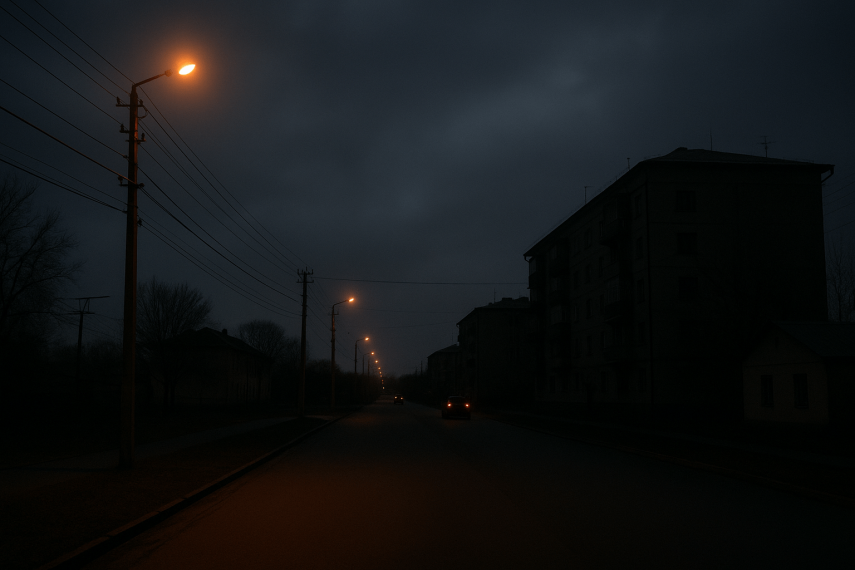
Uzbekistan has announced a new electricity rationing schedule as power shortages strain the national grid. The Ministry of Energy said temporary evening outages would help stabilize supply while repairs and emergency measures continue. The outages, which began this week, are concentrated during peak hours between 5:00 p.m. and 9:00 p.m. and are expected to last until mid-January.
The crisis stems from a major failure at the Syrdarya thermal power plant, one of the country’s largest. A newly installed Mitsubishi gas turbine suffered a mechanical fault in late November, forcing the station to shut down part of its capacity. A replacement 114-ton rotor was delivered by air on December 8, and engineers expect to finish installation and testing in four weeks.
Seasonal factors have also reduced the available power supply. With winter’s shorter daylight hours, output from solar stations has dropped significantly, increasing the load on the grid. An unexpected gas supply disruption has further strained generation: Energy Minister Jurabek Mirzamakhmudov revealed that an accident in a neighboring country’s network cut Uzbekistan’s gas intake by about 6 million cubic meters per day. Natural gas fuels a large share of the country’s power plants, so this drop in fuel supply, combined with cloudy weather, has constrained electricity production. “Because of rain, there was neither wind nor sun,” Mirzamakhmudov said. These factors combined have left the grid struggling to meet peak demand in early December.
Officials have emphasized that rolling blackouts will be kept brief and targeted; each outage is not expected to last more than about two hours, and consumers will be notified in advance whenever possible. By shedding some load at peak times, the grid can avoid more dangerous unplanned breakdowns and ensure critical facilities remain powered. Residents have also been urged to use electricity sparingly and to monitor official announcements, rather than panic if an interruption occurs.
The Energy Ministry has stressed that rumors of any nationwide “blackout” are unfounded, and any power cuts will be localized and limited in scope, not a return to the wide-ranging outages seen in the past. Citizens have been cautioned against spreading unverified information on social media and encouraged to rely on updates from authorities.
Winter months have historically tested Uzbekistan’s energy infrastructure. In previous years, electricity deficits forced scheduled outages – commonly known as rolling blackouts – across the country. However, officials note that the situation has improved markedly due to new power projects and efficiency measures. According to Energy Ministry data, the volume of electricity consumption that had to be curtailed through such restrictions fell from about 4 billion kWh in 2013 to just 357 million kWh in 2024. Even during the Central Asian energy crisis of winter 2022, Uzbekistan’s forced power cuts totaled around 2 billion kWh, a figure that has since sharply declined as new capacity comes online.
Uzbekistan has been racing to expand its electricity generation to meet growing demand and reduce chronic winter shortages. The government has partnered with international firms to build modern gas-fired plants and large renewable energy projects. As a result, wind and solar power output have surged. The country’s solar and wind farms generated a record 10 billion kilowatt-hours of electricity this year, saving an estimated 2.7 billion cubic meters of natural gas that would otherwise have been burned for power. Still, these gains can be hampered by seasonal conditions: on cold, overcast days, when new solar panels and wind turbines yield less energy. By announcing targeted evening rationing now, the authorities hope to manage the current shortfall in a controlled way and avoid a repeat of the widespread outages that have plagued past winters.
By The: The Times Of Central Asia.
Image: TCA.
SHARE YOUR OPINION AND DISCUSS THE ARTICLE ON OUR TELEGRAM CHANNEL!
Реклама
12.03.2026,
19:00
12.03.2026,
12:00
12.03.2026,
09:00

Реклама
Реклама

 Хроника