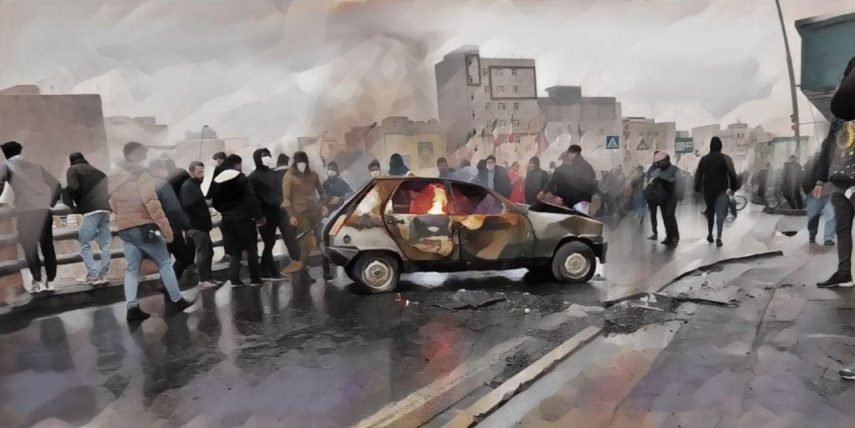
The wave of protests that erupted in Iran in late December and spread to at least 27 of the country’s 31 provinces has become the largest since 2022, when mass demonstrations followed the death of 22-year-old Mahsa AMINI in the custody of Iran’s morality police. The unrest has raised new concerns across the region about political stability, energy markets, and the risk of external intervention.
Rights monitors say protests have been reported in hundreds of locations nationwide, with death and detention tolls still contested. Human rights groups and independent monitoring organizations estimate that dozens of people have been killed and more than 2,000 detained, while Iranian officials have offered varying accounts and blamed violence on what they describe as “rioters.”
In Kazakhstan, observers are drawing comparisons to the country’s own January 2022 unrest, officially labeled an attempted coup that ended in a violent crackdown. But beyond the parallels with Kazakhstan’s ‘Qantar’ events, analysts are focusing on the wider implications, particularly the potential impact of Iran’s domestic turmoil on global oil markets.
For Kazakhstan, the stakes are heightened by the country’s reliance on hydrocarbon exports and the sensitivity of global energy markets to supply shocks. Any sharp change in Iranian output, even if temporary, could place downward pressure on prices and complicate budget planning for oil-dependent economies across Central Asia.
Kazakh financial analyst Rasul RYSMAMBETOV has voiced concern that unrest in Iran could trigger a surge in oil production aimed at funding social spending, a move that could drive down global oil prices and harm Kazakhstan’s oil-dependent economy.
“Iran could add half a million barrels a day within six months and cause oil prices to collapse, but it would not do so casually. The Middle East is very sensitive and knows how to negotiate. Still, if the protests persist, Tehran might ramp up production to finance social needs. [This would be] painful for Kazakhstan. If Venezuela is a bear cub, then Iran is a grizzly bear in the bushes with its oil,” Rysmambetov warned on his Telegram channel.
While political unrest typically raises oil prices by increasing supply risk, analysts note that Iran’s response could be atypical. Faced with fiscal pressure, Tehran may opt to increase production to stabilize revenues, a move that would push prices lower despite heightened instability.
Iran’s chronic social issues, exacerbated by inflation and the collapse of the national currency, have fueled public discontent for more than a decade. While the Iranian authorities acknowledge the severity of the economic crisis and have conceded that some demands are legitimate, they have also warned of further hardships. On January 5, the judiciary announced that no leniency would be shown toward those detained during the protests.
Russian experts, meanwhile, have framed the unrest in geopolitical terms. Irina FEDOROVA of the Russian Academy of Sciences’ Institute of Oriental Studies cited renewed sanctions, critical shortages of water and electricity, and foreign interference as the root causes. However, she dismissed the likelihood of regime change, pointing to disunity among opposition factions.
“The difference this time is that protesters are openly chanting monarchist slogans and demanding the overthrow of the Islamic regime. There’s even been talk of restoring the previous system. Another first is the president’s offer to negotiate, but he was quickly contradicted by Supreme Leader Ali KHAMENEI, who said protest is allowed, but not demands for regime change. So, there will be no dialogue,” said Michael BORODKIN, an Israeli researcher and Iran expert who runs the Telegram channel Oriental Express.
Borodkin argued that if President Donald TRUMP does not follow through on threats of U.S. intervention if repression continues, the Iranian regime is likely to crush the uprising.
The “Trump factor,” analysts say, is less about immediate action than about uncertainty. Trump’s warnings that Washington could intervene if Iranian authorities escalate violence have injected an external risk into an already volatile situation, prompting governments in the region to avoid public positions that could later prove costly.
This uncertainty appears to be influencing the muted response from Central Asian governments. Despite clear signals from Washington about potential U.S. intervention in Iran, leaders in the region, like their Russian counterparts, have avoided public statements directly addressing the protests. Moscow has limited itself to standard diplomatic expressions of concern.
That silence extends to other flashpoints as well. There has been no official reaction from Central Asia in response to the targeted extraction of Venezuelan President Nicolás MADURO, another crisis intertwined with Trump’s reasserted foreign policy posture.
The timing is awkward for regional diplomacy. Just weeks earlier, Iran had sought to deepen engagement with Central Asia, presenting itself as a stable partner despite mounting internal pressure and renewed sanctions. During a December visit by Iranian President Masoud PEZESHKIAN to Astana and Ashgabat, Tehran pushed plans to strengthen trade and economic cooperation with Central Asian partners, with a focus on transport, logistics, and industrial sectors.
It now seems that plans for regional cooperation with Iran may be indefinitely shelved amid growing geopolitical uncertainty.
By The: The Times Of Central Asia.
Image: TCA, Aleksandr Potolitsyn.
SHARE YOUR OPINION AND DISCUSS THE ARTICLE ON OUR TELEGRAM CHANNEL!
Реклама
05.03.2026,
13:30
06.03.2026,
14:00
05.03.2026,
09:00
05.03.2026,
10:30

Реклама
Реклама

 Хроника