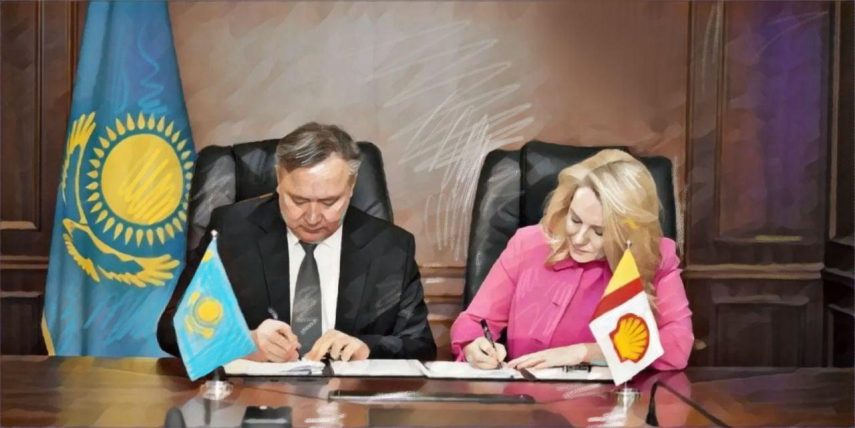
British energy company Shell has launched a new exploration project in Kazakhstan despite previously announcing that it would pause new investments in the country. On March 5, it was announced that Shell had signed a contract for geological exploration in the Aktobe region. The company has been involved in several legal disputes with Kazakhstan over subsoil use and had stated that it did not plan to invest further in the country’s energy sector.
Geological Exploration Contract
The Zhanaturmys site, which has attracted Shell’s interest, covers an area of 1,377 square kilometers and is located in one of Kazakhstan’s most actively developed oil and gas basins.
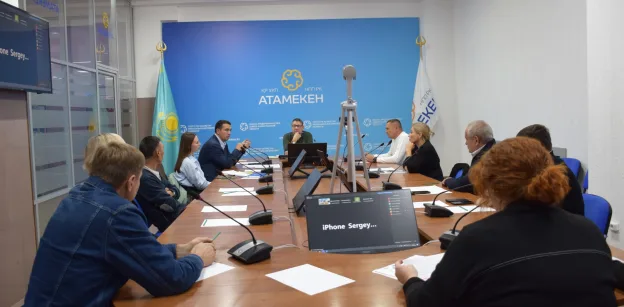
The document was signed by Kazakhstan’s Deputy Energy Minister, Yerlan AKBAROV, and Shell’s Senior Vice President and Chair in Kazakhstan, Suzanne COOGAN. The contract provides for seismic exploration, data collection, and technical assessments.
“The signing of today’s contract for geological exploration is further confirmation of Shell’s commitment to long-term cooperation with the Republic of Kazakhstan. Drawing on our global experience and advanced technologies, we intend to continue contributing to geological exploration and the expansion of the country’s resource base,” Coogan said.
The agreement will remain in force until 2032. The project will be implemented under the terms of an improved model contract. According to Kazakhstan’s Energy Ministry, the company will allocate at least 100 million tenge (about $200,000) to finance socio-economic development in the region where the site is located.
Shell is currently involved in three projects in Kazakhstan: the North Caspian Production Sharing Agreement (NCOC, 16.81% stake); the Karachaganak Production Sharing Agreement (29.25% stake); and the Caspian Pipeline Consortium (7.4% stake).
Kazakhstan produces around 1.8–1.9 million barrels per day and hosts some of the world’s largest offshore reserves in the Caspian Sea. Western energy majors, including Shell, Chevron, ExxonMobil, and Eni, have operated in the country for decades through complex production-sharing agreements.
Legal Disputes
In February, Shell CEO Wael SAWAN said the company would suspend new investments in Kazakhstan while legal proceedings with the government were ongoing. Numerous lawsuits filed by Kazakhstan, with claims amounting to billions of dollars, have reduced the company’s willingness to invest in the country, he said.
“This affects our desire to continue investing in Kazakhstan. Although we see many opportunities for investment in the future, we will wait until we have a clearer picture of how things will turn out,” Sawan stated.
Karachaganak and Kashagan
Kazakhstan is currently involved in several legal disputes with Western oil companies, both in national courts and international arbitration. The cases concern two major oil and gas projects.
One of them is Karachaganak. In 2023, the Kazakh government filed a lawsuit against the field’s developers over cost deductions. The initial claim amounted to $3.5 billion but later increased to $6 billion after additional claims were filed.
The project is operated by a consortium led by Eni and Shell, each holding a 29.25% stake. Other partners include Chevron (18%), Lukoil (13.5%, which has agreed to sell its stake), and KazMunayGas (10%).
In January, it was reported that Shell and its partners, Eni, Chevron, and Lukoil, had lost a dispute over cost deductions. Payments to Kazakhstan could reach $4 billion, although the consortium still has the right to appeal the decision.
Previously, investors had proposed settling the dispute by building a gas processing plant to meet Kazakhstan’s domestic needs.
Another dispute concerns the Kashagan project. The Kazakh government has challenged the terms of the long-term agreement for the Kashagan field and filed arbitration claims related to the Kashagan project that together could amount to about $160 billion.
Kazakh officials have argued that under the current terms, oil companies involved in the project, including Shell, ExxonMobil, Eni, TotalEnergies, CNPC, Inpex, and KazMunayGas, receive up to 98% of the revenue from oil production at Kashagan, leaving the country with only symbolic royalties.
There is also an ongoing dispute over sulfur storage at the Kashagan field, which authorities say constitutes an environmental violation. According to some reports, Kazakhstan’s total claims related to this project may reach $13.5 billion.
Nevertheless, Shell’s management appears to be continuing to seek new projects in Central Asia. The region’s importance for Europe has increased significantly following the war in Ukraine and the reduction of energy supplies from Russia.
By The: The Times Of Central Asia.
Image: TCA, Aleksandr Potolitsyn.
SHARE YOUR OPINION AND DISCUSS THE ARTICLE ON OUR TELEGRAM CHANNEL!

16.09.2026,
12:00
12.09.2026,
12:00
11.09.2026,
12:00
14.09.2026,
12:00



 Хроника